
AI Is Quietly Closing the Door on Entry-Level Jobs for Young Workers
LATESTJOBS


New Federal Reserve research reveals a 13% plunge in youth employment within high-tech sectors, signaling that artificial intelligence is erasing the "learning curve" roles rather than firing existing staff.
For years, the debate over artificial intelligence and jobs centered on a dramatic, Hollywood-style fear of mass layoffs. But according to new data from the Federal Reserve Bank of Dallas, the disruption is far quieter, more specific, and perhaps more insidious.
The robots aren’t coming for your job—they are coming for the job you haven't started yet. A new study released this month exposes a sharp divergence in the labor market: while established professionals remain secure, the "entry-level" rung of the corporate ladder is being systematically removed for the youngest generation of workers.
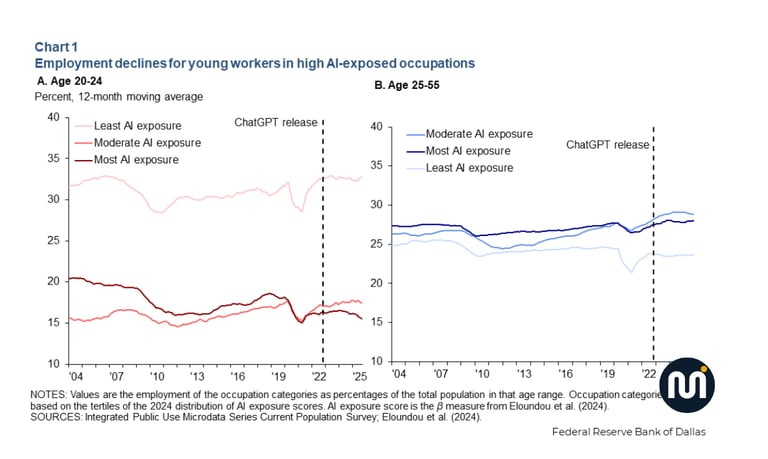
In a research paper published on January 6, 2026, economists at the Dallas Fed identified a startling trend in the U.S. labor market. Employment for young workers (specifically those aged 22 to 25) in occupations with "high AI exposure" has dropped by approximately 13% since late 2022.
The researchers, Tyler Atkinson and Shane Yamco, analyzed data following the mainstream explosion of generative AI tools like ChatGPT. Their findings debunk the myth of widespread AI-driven firing. Instead, they found that the decline is driven almost entirely by a hiring freeze at the entry level.
While older, experienced workers in these same sectors have seen their employment levels remain steady or even rise, young graduates are failing to transition from "out of the workforce" into these roles. Essentially, companies are still keeping their senior staff but are no longer hiring juniors to do the routine tasks that AI can now handle.
This "invisible" displacement has profound implications for the economy and the future structure of the corporate world.
For the Economy: While the aggregate impact on the national unemployment rate is currently small (adding roughly 0.1 percentage points), the concentration of this trend is alarming. It suggests a structural shift in how human capital is valued. If jobs that traditionally served as training grounds are automating away, the economy risks a future skills gap where mid-level professionals are scarce because they never got the chance to start.
For Young Professionals: This creates a "broken rung" on the career ladder. Entry-level jobs were never just about the output; they were paid apprenticeships where junior staff learned institutional knowledge. If those roles vanish, Gen Z and Gen Alpha face a formidable barrier to entry, potentially forcing them into lower-paid, low-AI-exposure service roles despite having high-level degrees.
For Businesses: Short-term efficiency gains may lead to long-term fragility. By substituting junior associates with software, firms are cutting costs today but failing to cultivate the leadership pipeline of tomorrow. Who will manage the strategy in 2036 if no one is hired to learn the ropes in 2026?
To understand this shift, one must look at the nature of "AI exposure." Unlike the automation of the 1980s and 90s, which targeted repetitive manual tasks (blue-collar roles), the generative AI wave of the 2020s targets "cognitive drudgery."
High AI Exposure Roles: These include financial analysts, software developers, copywriters, and paralegals.
The Mechanism: An entry-level analyst might spend 40 hours summarizing reports or cleaning data. An AI can now do that in seconds. A senior partner still needs to review the work (high value), but the junior analyst (lower value) becomes redundant.
This mirrors the "hollowing out" of the middle class seen in manufacturing, but it is moving up the value chain to white-collar professions. The Dallas Fed’s data confirms what hiring managers have quietly admitted for two years: they are raising the bar for entry-level hires, expecting them to do mid-level work immediately.
As we move deeper into 2026, several scenarios are likely to unfold:
Credential Inflation: With basic tasks automated, entry-level candidates may need even more advanced degrees or specialized certifications to prove they can add value beyond what an algorithm provides.
New "Apprenticeship" Models: Companies may need to reinvent on-the-job training. If "learning by doing" (e.g., writing basic code or drafting simple emails) is no longer profitable, firms might create formal, unpaid, or stipend-based training programs similar to medical residencies.
Policy Response: If youth unemployment in high-skill sectors continues to diverge from the broader market, pressure will mount on universities to overhaul curricula, shifting focus from information retention to AI management and complex problem-solving.
1. Which jobs are considered "High AI Exposure"? These are typically roles involving information processing, writing, coding, or data analysis. Examples include junior software engineers, marketing assistants, paralegals, and financial researchers.
2. Is this causing a recession? Not currently. The Dallas Fed notes that because this specific demographic is a small portion of the total workforce, the impact on the overall unemployment rate is negligible (about 0.1%). However, it signals a long-term structural issue.
3. Should students avoid these fields? Not necessarily, but they must adapt. Students should focus on skills AI cannot easily replicate, such as strategic thinking, complex negotiation, emotional intelligence, and high-level oversight of AI outputs.
What can I do for you next? Would you like me to find recent data on which specific industries are currently increasing their entry-level hiring to contrast with this report?
How Automation Changes Labor Entry Points
Historically, technology tends to be a net creator of jobs, but it permanently alters entry points.
The ATM Effect: When ATMs appeared, bank teller jobs didn't disappear; they changed. Tellers became sales associates, focusing on mortgages and credit cards rather than counting cash.
The Difference Now: The speed of AI adoption is faster than previous industrial shifts. Usually, displaced workers move to sectors where human touch is premium (e.g., healthcare, trades). However, the friction is higher here because the displaced workers are often university graduates with significant student debt, expecting white-collar careers that are rapidly shrinking.
Key Takeaways
Youth Specific: The employment drop is concentrated among workers aged 22–25; older professionals in the same sectors remain unaffected.
Hiring, Not Firing: The decline is due to a lack of new hiring (inflows) rather than layoffs of existing staff.
13% Drop: Employment for young workers in high-AI-exposure fields has fallen by 13% since the release of major generative AI tools.
Skill Gap Risk: The automation of entry-level tasks threatens the traditional method of training future senior leaders.
Uneven Impact: The trend highlights a disconnect between a resilient aggregate economy and a precarious specific demographic.
Related Stories
The Money Impact © 2026
Business and finance explained by impact.
