
Global Markets Stumble as Tariff Threats Hit US Futures on Holiday
LATESTMARKET
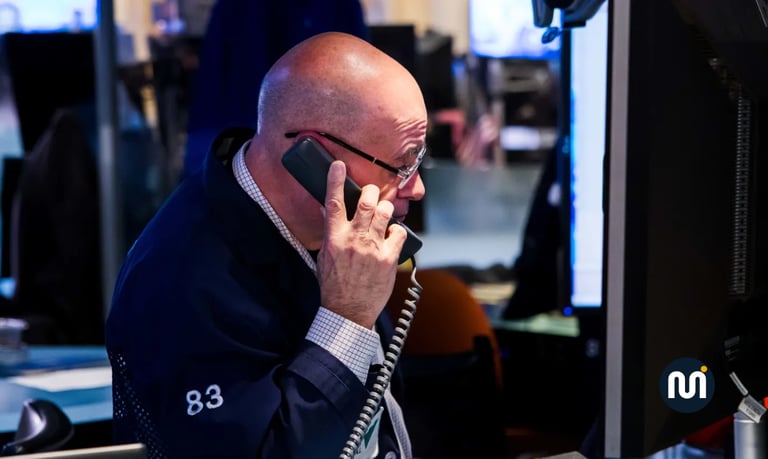
While US exchanges remained shuttered for MLK Day, stock futures tumbled and safe-haven assets hit record highs following renewed trade war rhetoric targeting European allies.
Global financial markets began the week on shaky ground, with US stock futures sliding significantly despite cash markets being closed for the Martin Luther King Jr. holiday. The catalyst for the volatility was a sudden escalation in geopolitical tensions, as the White House threatened new tariffs on key European trading partners. The move sent European indices lower and triggered a rush into gold and silver, signaling a potentially turbulent reopening for Wall Street on Tuesday.
What Happened
Traders monitoring the market on Monday faced a sea of red. With the NYSE and Nasdaq closed, action was concentrated in futures and international exchanges.
Futures Drop: S&P 500 futures fell approximately 1%, while the tech-heavy Nasdaq 100 futures shed nearly 1.4%. Dow Jones Industrial Average futures were off by roughly 0.8%.
Tariff Threat: The sell-off was triggered by President Trump’s announcement threatening a 10% tariff on imports from eight European nations, including France, Germany, and the UK. The administration cited these nations' opposition to US strategic interests regarding Greenland as the justification.
Europe Hit: The reaction in Europe was immediate. The pan-European Stoxx 600 dipped, with France’s CAC 40 plunging nearly 2% and Germany’s DAX losing over 1.3% as export-heavy industries priced in the risk of a new trade war.
Commodities Surge: In a classic flight to safety, precious metals skyrocketed. Gold futures breached $4,670 per ounce, a new all-time high, while silver rallied past $94 per ounce.
The divergence between soaring commodities and falling equities highlights a spike in "risk-off" sentiment that impacts investors, businesses, and consumers alike.
For the Economy: The threat of tariffs reignites fears of stagflation—stagnant growth coupled with inflation. If implemented, these levies would raise costs for US consumers and disrupt supply chains for American companies relying on European components. For Europe, already grappling with sluggish growth, a trade spat with its largest export partner could tip the region into recession.
For Your Portfolio: The "Greenland Tariffs" narrative challenges the soft-landing consensus that buoyed markets entering 2026. High-growth tech stocks, which are sensitive to global stability, are under pressure. Conversely, the surge in gold and silver suggests investors are hedging against currency debasement and policy unpredictability.
For Businesses: Multinational corporations face renewed uncertainty. Companies like luxury goods conglomerates (heavily weighted in the CAC 40) and German automakers are directly in the crosshairs. Meanwhile, US insurers saw some activity, with Zurich Insurance making a bid for UK-based Beazley, proving that deal-making hasn’t halted completely despite the gloom.
Monday’s volatility doesn't happen in a vacuum. It follows a weekend of mixed economic signals from Asia.
Just yesterday, China confirmed it met its 5% GDP growth target for 2025. However, the details revealed a deflationary expansion driven by exports rather than domestic consumption. This "cheap goods" flood has already put global trade relations on edge. The addition of a transatlantic trade dispute creates a two-front economic conflict for the US: one with China over manufacturing overcapacity, and now one with Europe over geopolitical alignment.
Furthermore, January is traditionally a critical month for setting the year's tone. The "January Barometer" suggests that how the market performs this month often predicts the year's trajectory. With the S&P 500 currently facing headwinds, the historical probability of a bullish 2026 is being stress-tested.
What Happens Next
All eyes turn to the opening bell on Tuesday, January 20.
Tuesday Reopening: Analysts expect a gap-down open for US stocks as cash markets catch up to the futures pricing. The extent of the decline will depend on whether the administration softens its rhetoric or doubles down.
Earnings Season: The political noise threatens to overshadow corporate fundamentals. Key earnings reports are due later this week, including Netflix and Johnson & Johnson. Strong guidance from these giants could help stabilize sentiment.
Davos Watch: With the World Economic Forum kicking off in Davos this week, comments from central bankers and world leaders will be scrutinized for any coordinated response to the new tariff threats.
Volatility During Market Holidays
Market holidays like Martin Luther King Jr. Day often exacerbate volatility in the futures and global markets due to low liquidity.
When the primary liquidity providers (US banks and institutions) are offline, it takes less volume to move prices significantly. A headline that might cause a 0.5% drop on a normal trading day can trigger a 1.5% swing on a holiday because there are fewer buyers to step in and absorb the selling pressure. This phenomenon, known as "thin trading," means Monday’s futures moves might be an overreaction—or a warning that the smart money is exiting before the retail crowd returns.
Key Takeaways
Futures Slide: US stock futures dropped sharply (Nasdaq -1.4%) despite markets being closed for MLK Day.
Tariff Shock: New 10% tariff threats against European allies over the "Greenland issue" sparked the sell-off.
Global Impact: European indices fell significantly, led by a nearly 2% drop in France's CAC 40.
Safe Havens: Gold and silver hit fresh record highs as investors fled risk assets.
China Backdrop: Weak inflation data from China is adding to the deflationary fears weighing on global sentiment.
FAQ
1. Why do futures trade when the stock market is closed? Stock market futures trade on the Chicago Mercantile Exchange (CME) Globex system, which operates nearly 24 hours a day, Sunday through Friday. This allows investors to hedge positions or react to global news events even when the New York Stock Exchange is closed for holidays.
2. How do tariffs affect the stock market? Tariffs generally hurt stock prices because they act as a tax on businesses and consumers. They increase costs for companies (lowering profit margins) and can lead to higher prices for shoppers (lowering demand). They also invite retaliation, reducing sales for US exporters.
3. What should I do when the market opens after a drop in futures? Panic selling is rarely a winning strategy. Often, the initial "gap down" at the open is bought up by institutional investors looking for discounts. Review your portfolio to ensure you are comfortable with your risk level, but avoid making impulsive decisions based on holiday headlines.
Related Stories
The Money Impact © 2026
Business and finance explained by impact.
