
Hidden Door Handle Ban: Why Your Tesla & Insurance Bill May Change
LATESTECONOMY
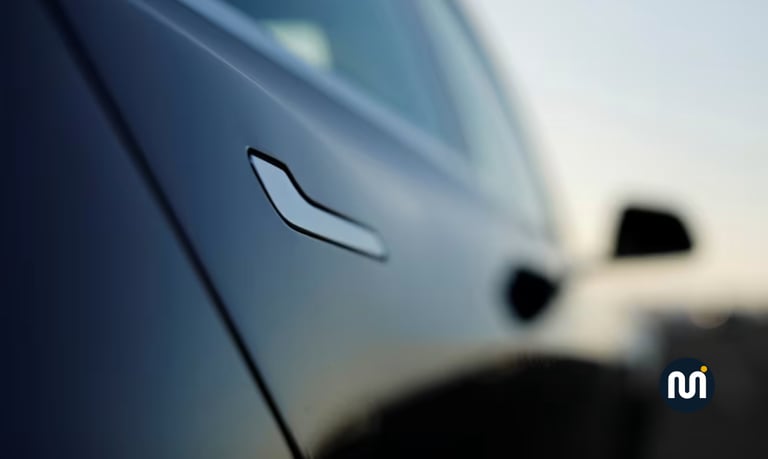
China just banned "hidden" car door handles for 2027. Here is how this safety shift impacts your car’s resale value, insurance rates, and EV investments.
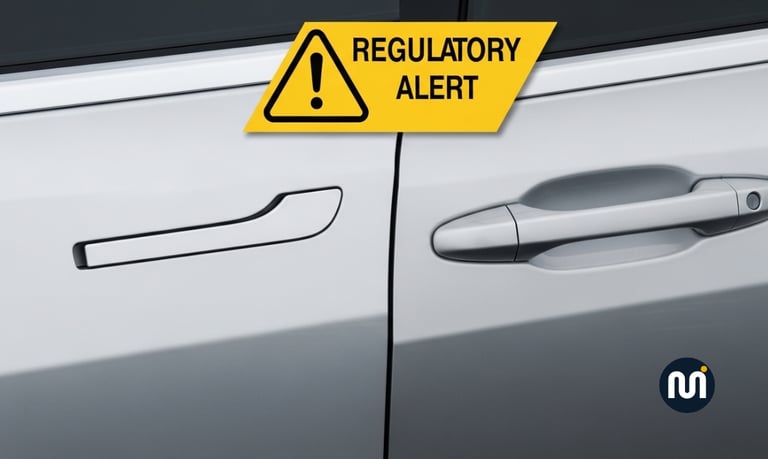
China Bans "Flush" Door Handles Citing Safety Risks On February 3, 2026, China’s Ministry of Industry and Information Technology dropped a regulatory hammer on the Electric Vehicle (EV) industry: effective January 1, 2027, "hidden" or flush door handles—the kind popularized by Tesla to improve aerodynamics—will be banned on new cars.
The regulation requires all vehicle doors to have a mechanical release accessible externally during emergencies. This follows a string of high-profile accidents where rescuers were unable to extract passengers from burning vehicles because the electronic handles failed or were retracted.
Why This Matters to You You might be thinking, "I don't live in China, why do I care?"
You care because car manufacturing is global. When the world's largest car market (China) bans a core design feature, global automakers like Tesla, BMW, and Volkswagen don't just change the car for China; they often change it everywhere to keep assembly lines simple and cheap.
This is the end of the "Gadget Era" of cars. For the last decade, automakers have been removing buttons and handles to make cars look like iPhones. This ruling signals that the pendulum is swinging back toward utility and safety. The "cool factor" of your car is now colliding with the "staying alive" factor, and safety is winning.
The Headline: "Tesla Forced to Change Door Handles in China." The Reality: "The Resale Value of 'Flush Handle' Cars Just Took a Hit."
The media is treating this as a manufacturing headache for Elon Musk. The "Smart Money" is looking at Asset Depreciation.
If you own a car with flush handles today (Tesla, Hyundai Ioniq 5, etc.), your car has just been flagged by a major government as "structurally unsafe in a crash." In the used car market, perception is reality. If buyers start viewing flush handles as a safety liability rather than a luxury feature, the resale value of your vehicle could soften faster than expected.
Think of this like Asbestos in the 1970s (but less toxic). For years, builders used asbestos because it was a great insulator (efficient). Then, regulators realized it was dangerous, and suddenly, buildings containing it became liabilities, not assets.
In the EV world, flush handles were used to reduce wind drag and squeeze out a few extra miles of range (Efficiency). Now, the "Regulatory Engine" is prioritizing Resilience over Efficiency.
This adds Friction Costs to the economy. Automakers have to spend billions retooling factories. That money has to come from somewhere—either they raise car prices, or their stock price takes a hit because their profit margins shrink.
Your Wallet
Here is how this design shift hits your personal finances:
Your Cost of Living (Insurance): Watch Out. Insurance companies love data. If China’s data proves that flush handles lead to higher fatality rates (because rescuers can’t get in), U.S. insurers will adjust their algorithms. You could see premiums rise for vehicles with "electronic-only" entry systems, categorized under "higher total loss risk."
Your Assets (Car Resale): Negative. If this ban goes global (and the EU is likely next), cars with flush handles will look "dated" and "unsafe" by 2028. We may see a split in the used market: "Legacy Tech" (flush handles) vs. "Safety Standard" (mechanical handles). Avoid overpaying for a used EV with this feature right now.
Your Investments: Volatility. If you hold TSLA or broadly diversified EV ETFs, expect short-term turbulence. Retooling production lines for the 2027 deadline is expensive. However, "Boring" legacy automakers (Ford, Toyota) who were slower to adopt flush handles might see a slight competitive advantage as they don't have to redesign their fleets.
For your life
Check Your Insurance Policy: If you drive a Tesla or a modern EV with flush handles, shop your rate at your next renewal. If you see a spike, ask the agent if "safety features" are a factor.
Don't Buy for "Cool": If you are in the market for a car in 2026, prioritize physical controls. Buttons and handles are "future-proof" against safety regulations. Screens and flush handles are risk points.
Audit Your EV Stocks: Look at the automakers in your portfolio. Are they "Pure Play" EVs (100% reliant on these designs) or diversified? Companies that can pivot design quickly without going broke are the ones you want to hold.
Don't let the economy surprise you. Join our newsletter to stay ahead of the curve.
Related Stories
The Money Impact © 2026
Business and finance explained by impact.
