
How to Invest in Japanese Equities: A 2026 Guide to the "Rising Sun" Bull Market
Learn how to invest in the 2026 Japanese market rally. This guide covers the best ETFs ($DXJ, $EWJ), top stocks like Sony, and a step-by-step tutorial for global investors.


The Dow Jones hitting 50,000 is the headline, but the real structural shift is happening in Tokyo. In February 2026, the convergence of Prime Minister Sanae Takaichi’s aggressive fiscal stimulus and the revitalization of the Japanese technology sector has created a generational entry point for global investors.
Allocating capital to Japan in 2026 is no longer a "contrarian" play; it is a diversification necessity. With US equity multiples at historic highs, Japan offers a unique combination of low valuations, corporate governance reform, and a supermajority government committed to ending decades of deflation. This guide outlines how to capitalize on this trend using global platforms and institutional-grade vehicles.
The Best Investment Vehicles
To capture the "Japan 2026" trend, you need exposure that balances growth with currency protection. Here are the three most effective assets:
1. WisdomTree Japan Hedged Equity Fund ($DXJ)
Bull Case: This is the "gold standard" for 2026. It tracks dividend-paying Japanese exporters while hedging against Yen fluctuations. If the Yen weakens due to Takaichi’s stimulus, your returns aren't eroded. Bear Case: If the Bank of Japan (BoJ) surprises markets with a hawkish rate hike that rapidly strengthens the Yen, this hedged ETF will underperform unhedged versions.
2. iShares MSCI Japan ETF ($EWJ)
Bull Case: Provides broad exposure to the "titans" of the Japanese economy, including Toyota, Sony, and Mitsubishi Financial. It is highly liquid and ideal for long-term "set and forget" investors. Bear Case: Unlike $DXJ, $EWJ is unhedged. You are taking a direct bet on both Japanese stocks and the Yen. Currency volatility can significantly impact your total USD return.
3. Sony Group Corporation ($SONY)
Bull Case: A pure-play on the intersection of AI and Entertainment. Sony is a major beneficiary of the tech relief rally, dominating in sensors, gaming, and semiconductors. It trades on the NYSE, making it easily accessible. Bear Case: High sensitivity to global consumer spending. A recession in the US or Europe would hit Sony’s PlayStation and electronics divisions regardless of Japan’s internal stimulus.
Executing Your Trade
Step 1: Choosing a Global Broker
To trade these assets, you need a broker with deep liquidity and international reach.
Interactive Brokers (IBKR): The best for "Smart Money." It offers direct access to the Tokyo Stock Exchange (TSE) if you want to buy local tickers (e.g., 6758.T).
eToro: Ideal for social trading and those looking to copy successful Asian-market specialists.
Robinhood: Best for US-based beginners looking to trade $DXJ or $SONY with zero commissions.
Step 2: Analyzing the Ticker
Before buying, check the Expense Ratio (for ETFs like $DXJ, expect around 0.48%) and the P/E Ratio. In 2026, many Japanese firms still trade at a discount to their S&P 500 peers, offering a significant "margin of safety."
Step 3: Executing the Order
Market Order: Fills immediately at the best available price. Use this for high-liquidity ETFs like $EWJ.
Limit Order: (Recommended) Set a specific price you are willing to pay. Given the time difference between the NYSE and the TSE, limit orders protect you from "gap ups" during the overnight session.
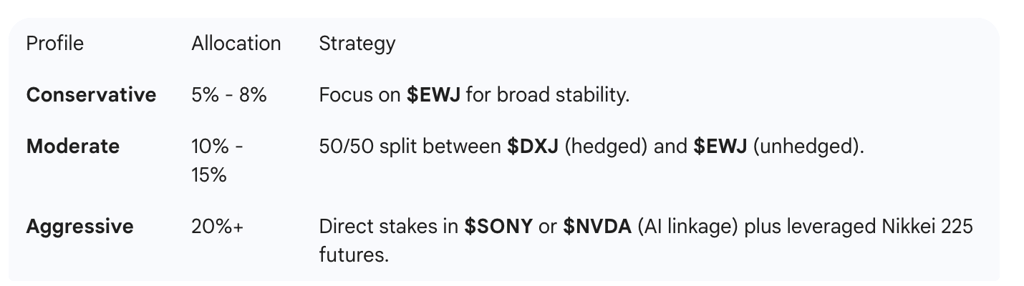
Risk Management: Portfolio Allocation
The "Japan Trend" should be treated as a growth booster, not your entire foundation.
FAQ: Investing in Japan 2026
1. Is it too late to buy since the Dow hit 50,000? No. While the Dow represents US sentiment, the Nikkei 225 is in a separate structural bull cycle driven by Japanese domestic policy. Valuations in Japan remain significantly lower than in the US.
2. Should I worry about the "Yen Carry Trade" collapsing? The 2026 victory of the LDP has stabilized expectations. While volatility exists, the current "Smart Money" view is that the BoJ will remain more accommodative than the Fed, keeping the carry trade viable for the mid-term.
3. Can I buy these stocks from outside the US? Yes. Platforms like Binance (for tokenized assets) or Interactive Brokers allow investors from the UK, Europe, and Asia to access these tickers seamlessly.
The Dow 50,000 milestone is a signal that global liquidity is searching for its next home. With a pro-growth government in Tokyo and a tech sector finding its second wind, the window to enter the Japanese market at reasonable valuations is closing.
Your next step: Open an account on Interactive Brokers or eToro, search for $DXJ, and place a small "starter" position to capture the momentum of the 2026 Pacific Rally.
Related Stories
The Money Impact © 2026
Business and finance explained by impact.
