
How to Invest in the "AI Industrial Revolution" (2026 Guide)
The $650 Billion AI Infrastructure Boom is here. Learn how to invest in the physical backbone of Artificial Intelligence—from Chips to Nuclear Energy—with this step-by-step guide for global investors.

Why Allocate Capital Now?
The headline is simple: $650 Billion. That is the combined capital expenditure (Capex) pledged by Amazon, Microsoft, Google, and Meta for 2026 alone. To put that in perspective, this rivals the GDP of mid-sized nations like Sweden or Belgium.
But here is the "Smart Money" secret: Software is speculative; Infrastructure is inevitable. While we don't know which AI chatbot will win the consumer war in 2030, we do know that every single one of them requires massive amounts of Compute (Chips), Space (Data Centers), and Power (Energy).
We are witnessing the largest industrial build-out since the post-WWII era. By allocating capital to the "Physical Layer" of AI, you are not betting on a lottery ticket; you are investing in the utilities of the 21st century. This guide will show you how to position yourself as the "Landlord" and "Utility Provider" for the digital age.
The Best Investment Vehicles
To capture the full value chain of this $650B spend, we need exposure to the Brain, the Body, and the Fuel of AI.
1. The Brain: Nvidia Corporation ($NVDA)
Role: The absolute monopoly on AI Compute.
The Bull Case: Nvidia is no longer just a chip company; it is a nation-state of compute. With the Blackwell B200 platform sold out through 2027, their revenue is contractually locked in. As Big Tech spends $650B, roughly 40-50% of that flows directly into Nvidia's coffers.
The Bear Case: Antitrust & Geopolitics. If the US government restricts exports further, or if China invades Taiwan (where chips are made), the stock could face a catastrophic 30-50% drawdown overnight.
2. The Body: Equinix, Inc. ($EQIX)
Role: The world's digital landlord (Data Center REIT).
The Bull Case: You can't download a server rack. It needs physical space, cooling, and security. Equinix owns the most critical "interconnection points" of the internet. As "Hyperscalers" run out of space, they must lease from Equinix at premium rates. It pays a steady dividend, offering a defensive layer to your portfolio.
The Bear Case: Interest Rates. As a Real Estate Investment Trust (REIT), Equinix relies on debt to build. If global interest rates spike again, their borrowing costs rise, hurting profitability and share price.
3. The Fuel: Global X Uranium ETF ($URA)
Role: The energy source for the AI grid.
The Bull Case: AI data centers are energy vampires. Microsoft has already inked deals to restart nuclear plants because wind and solar are too intermittent for AI's 24/7 needs. $URA gives you a basket of the world's largest uranium miners (like Cameco) who are fueling this nuclear renaissance.
The Bear Case: Regulation & Accidents. Nuclear energy is politically sensitive. A safety incident anywhere in the world, or a shift in government policy (e.g., Germany's anti-nuclear stance spreading), could crush sentiment.
Investing globally in 2026 is accessible to almost anyone with a smartphone. Here is how to execute this strategy safely.
Step 1: Choosing a Global Broker
You need a platform that offers access to US Markets (NYSE/NASDAQ) and handles currency conversion efficiently.
Interactive Brokers (IBKR): The professional's choice. Lowest margin rates, access to 150+ markets, and superior execution.
eToro: Best for beginners. User-friendly interface and "CopyTrading" features allow you to mimic institutional portfolios.
Robinhood / Schwab: Excellent if you are a US resident or have a US bank account.
Mentor Tip: Avoid "CFD" (Contract for Difference) brokers if you plan to hold long-term. You want to own the underlying asset, not a derivative that charges overnight fees.
Step 2: Analyzing the Ticker
Before you buy $NVDA or $EQIX, look at two key metrics on your broker's dashboard:
P/E Ratio (Price-to-Earnings): Is it historically high? For Nvidia, a P/E of 30-40x is standard growth. If it hits 80x, wait for a dip.
RSI (Relative Strength Index): If the RSI is above 70, the stock is "Overbought" (too expensive short-term). Wait for it to cool down to 50 or below.
Step 3: Executing the Order
Never simply click "Buy" at the market price. You are giving away money to high-frequency traders.
Bad: Market Order. "Buy 10 shares of NVDA at whatever price is available now." (You might pay $145.50 when the price was $145.00).
Good: Limit Order. "Buy 10 shares of NVDA only if the price is $145.00 or lower." This guarantees your entry price.
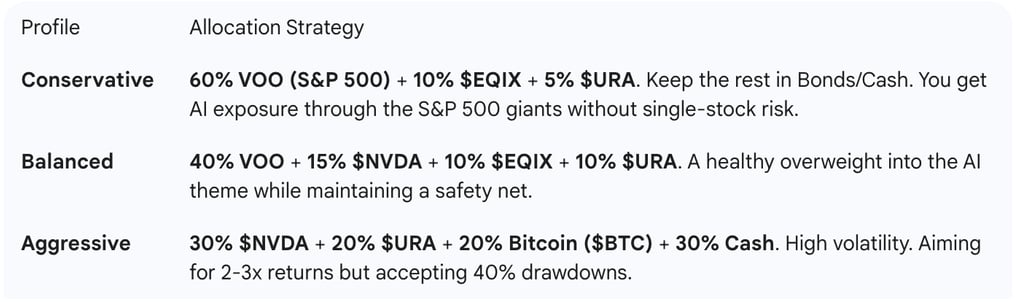
Risk Management: Portfolio Allocation
Don't bet the farm on one trend. Here is how to size your position based on your risk tolerance:
FAQ: Common Questions
1. Is it too late to buy Nvidia? Short answer: No. Long answer: While the "easy money" of 2023 is gone, Nvidia is now a utility. You invest in it for steady compounding as AI becomes the global standard, similar to investing in Apple in 2015.
2. Why Uranium ($URA) and not Solar ($TAN)? Data centers require "Base Load" power—energy that is on 100% of the time. Solar goes dark at night; wind stops blowing. Nuclear is the only carbon-free source that runs 24/7, making it the preferred partner for Microsoft and Amazon.
3. What happens if the AI Bubble bursts? If AI hype dies, software stocks will crash 80%. However, Infrastructure ($EQIX) and Energy ($URA) have real-world value outside of AI. We still need data storage and electricity. This is why we focus on the "Physical Layer"—it offers a floor to your risk.
The $650 billion spending spree by Big Tech is a signal that the digital world is becoming heavy, expensive, and industrial. By owning the chips ($NVDA), the real estate ($EQIX), and the fuel ($URA), you are positioning yourself on the profitable side of this history.
Your Next Step: Log into your brokerage account today. Add $NVDA, $EQIX, and $URA to your watchlist. Set a "Limit Order" for a small starter position (e.g., 1 share) to get "skin in the game."
Related Stories
The Money Impact © 2026
Business and finance explained by impact.
