
The Greenland Gamble: Why Geography Just Became the Biggest Risk to the Global Economy
LATESTECONOMY
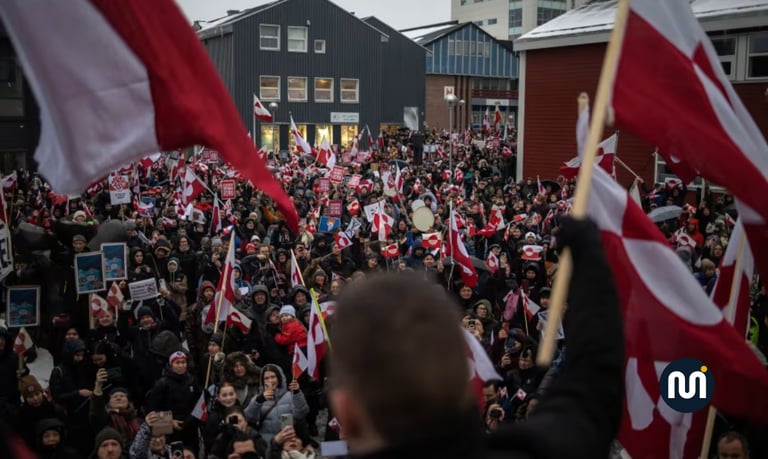

A shock ultimatum from the White House has linked Greenland's sovereignty to global trade tariffs. Here is how this geopolitical twist threatens the stability of the entire economy.
The New Price of Sovereignty
The rules of the global economy changed this January, and it had nothing to do with interest rates or inflation data. In a move that has rattled markets from Frankfurt to New York, the White House has explicitly linked the purchase of Greenland to the stability of transatlantic trade. The ultimatum is stark and unprecedented: eight European nations must facilitate the sale of the semi-autonomous territory to the United States, or face immediate, punishing tariffs.
This is not standard diplomatic posturing. It is a hostile takeover bid applied to a landmass, with the global economy held as collateral. For investors and business leaders, the message is clear: geopolitical borders are no longer just lines on a map—they are negotiable assets, and the currency being used to buy them is the stability of your supply chain.
The "Art of the Deal" Returns with a Vengeance
To understand the macro impact, we have to look at the specifics of the proposal. The administration has threatened a blanket 10% tariff on all imports from a specific bloc of European allies—including Germany, France, and the Nordic nations—unless negotiations for the transfer of Greenland begin immediately. If a deal isn't struck by summer, those tariffs ratchet up to 25%.
This is the financial equivalent of a sledgehammer. These nations aren't just allies; they are the industrial engines of the West. By targeting them, the U.S. is essentially importing inflation. When you tax German machinery or Swedish telecommunications tech, the cost of doing business in America goes up.
The logic from the Oval Office is transactional. Greenland is viewed not as a nation, but as a strategic real estate asset essential for dominance in the Arctic—a region rich in rare earth minerals and crucial for future shipping lanes. But by using trade tariffs as the negotiation tool, the administration has merged national security interests with economic policy in a way we haven't seen since the 1930s.
Why This Hits Your Wallet (And Your Portfolio)
You might be thinking, "I don't buy Danish real estate, so why do I care?"
Here is the reality: The global economy is an interconnected web. You cannot pull a thread in the Arctic without vibrating the entire structure.
1. The Inflationary Echo We have spent years fighting to stabilize prices. Tariffs are, by definition, a tax on consumption. If these measures go into effect, the price of imported goods rises. Domestic manufacturers who rely on European parts face higher costs. Inevitably, those costs are passed down to you. The Federal Reserve can raise interest rates to fight demand-side inflation, but they can't print more shipping containers or lower the cost of tariffs.
2. The CapEx Freeze Uncertainty is the enemy of growth. If you are a CEO planning a factory expansion or a major hire, you pause. You don't know if your raw materials will cost 10% or 25% more in six months. This "wait-and-see" approach slows down the velocity of money. It cools the labor market. It stalls GDP growth.
3. The Retaliation Risk Europe has its own "bazooka"—the Anti-Coercion Instrument (ACI). They have signaled they will use it. This allows the EU to target American digital services and intellectual property. Suddenly, a dispute over an island becomes a war over cloud computing revenue and tech stocks.
The Pivot to "Real Assets"
The market's reaction has been telling. We are seeing a swift rotation out of growth stocks and into "hard" assets. Gold, commodities, and defense contractors are rallying. Why? Because in a world where trade agreements can be shredded over a real estate dispute, intangible assets feel risky.
Investors are betting on the things you can drop on your foot. If the Arctic is the new prize, then the companies that build icebreakers, mine rare earth metals, and secure borders are the new darlings of Wall Street. It is a cynical trade, but a logical one.
The Enduring Lesson
What does this specific shock teach us about the next three years?
Politics is now a Fundamental.
For decades, we operated under the illusion that free trade was inevitable and that politics was just background noise. That era is over. The "Enduring Lesson" is that political risk is no longer an outlier; it is a primary driver of asset valuation.
When you look at your investments for the coming years, you cannot just analyze a company's balance sheet. You have to analyze its geopolitical exposure. Is its supply chain located in a region that could become a bargaining chip? Is its revenue dependent on a treaty that could be revoked via tweet?
The economy of the future isn't just about supply and demand; it's about leverage and territory. The Greenland ultimatum is a wake-up call: diversification now means more than just owning different stocks—it means hedging against the whims of history.
Related Stories
The Money Impact © 2026
Business and finance explained by impact.
