
The New Industrial Oligopoly: Why the $650 Billion AI Spend Is a Defensive Moat, Not a Bubble
Is the AI rally a replay of the Dotcom burst or the birth of a new industrial complex? We analyze the geopolitical and structural shifts driving Microsoft and Nvidia, and why 2026 marks the end of the "Open Internet."
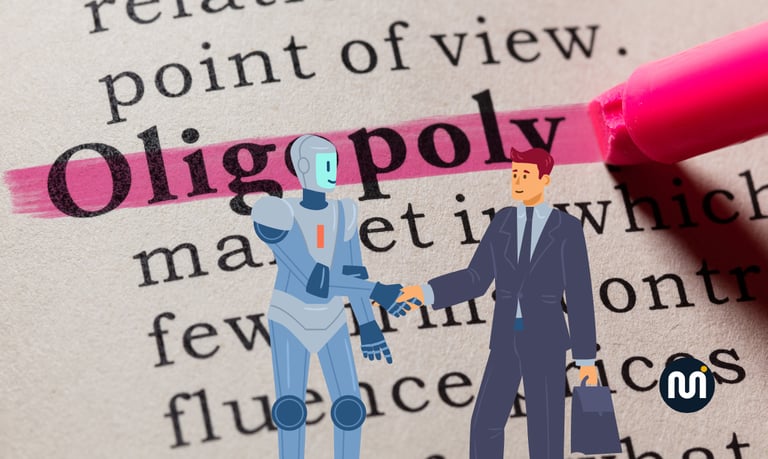

The financial press is currently fixated on the headline number: a staggering $650 billion in collective capital expenditure pledged by the "Hyperscalers" for 2026. Retail investors see this as a signal of unbridled growth, a repeat of the roaring 2020s. However, viewed through the lens of institutional capital allocation, this spending spree is not an offensive play for new markets—it is a defensive fortification of the most expensive economic moat in history. We are not witnessing a bubble in the traditional sense; we are witnessing the industrialization of cognition, a transition as capital-intensive and disruptive as the electrification of the global economy in the early 20th century.
For the past decade, the "Smart Money" operated under the assumption of zero-interest-rate policy (ZIRP) and infinite scalability of software. That era is dead. The last five years (2021-2026) have exposed the fragility of global supply chains and the geopolitical liability of semiconductor reliance. As the Dow crosses 50,000, the market is no longer rewarding "growth at all costs." It is rewarding "sovereignty at any price." Microsoft and Nvidia are no longer just technology stocks; they have evolved into critical infrastructure utilities, effectively privatized extensions of Western geopolitical power.
The Core Thesis: The "Capex Cold War" and the Death of Competition
The invisible "Alpha" in this market is not innovation, but capital inefficiency. In a classic free market, high profit margins attract competition. However, the AI paradigm of 2026 has inverted this logic. The cost of entry to train a frontier model—requiring gigawatts of power and clusters of Nvidia Blackwell GPUs costing tens of billions—has become so prohibitively high that it has created a natural monopoly.
We are entering the era of the "Capex Cold War." The $650 billion spending wall being erected by Microsoft, Amazon, and Google is designed to do one thing: bankrupt the competition before they can even launch. This draws a stark parallel to the Railway Mania of the 1840s or the Standard Oil consolidation. The winners weren't necessarily the ones with the best trains or the best oil; they were the ones who owned the rails and the refineries.
Nvidia’s dominance (NVDA) is not a product of hype; it is a product of supply chain capture. By controlling the CUDA software stack and the hardware supply, Nvidia has become the central bank of compute. Microsoft (MSFT), by integrating this compute into the operating system of the global workforce via Copilot, has become the tax collector. The "Alpha" here is recognizing that these companies have effectively decoupled from the business cycle. They are building the digital equivalent of nuclear power plants, assets that will generate rent for the next fifty years, regardless of whether a recession occurs in 2027.
Winners and Losers: The Bifurcation of Value
As this capital deployment accelerates, the market will bifurcate violently. The rising tide will not lift all boats; it will drown the small ones.
The Winners: The "Physical" Enablers
The Nuclear Renaissance ($URA, $CCJ): The second-order consequence of AI is an energy crisis. Data centers in 2026 are consuming power equivalent to mid-sized nations. The "Smart Money" is heavily long on uranium and Small Modular Reactor (SMR) developers. Microsoft’s energy contracts are the canary in the coal mine—tech is becoming an energy heavy industry.
Sovereign Wealth Funds: The only entities with enough liquidity to partner with Big Tech on infrastructure projects are nation-states (UAE, Saudi Arabia, Norway). Expect a massive inflow of petrodollars into US Tech infrastructure, further cementing the dollar’s dominance despite BRICS noise.
The "Foundry" States: Arizona and Japan. With TSMC and Rapidus expanding fabrication, real estate and regional banks in these "silicon shields" will outperform as the supply chain onshores.
The Losers: The "Middle-Class" Tech
SaaS Mid-Caps: The era of the $10 billion B2B software company is over. If your product is a "wrapper" around an LLM, you are not a business; you are a feature on Microsoft’s roadmap. Expect a wave of acquisitions at distressed valuations similar to the post-2000 consolidation.
Legacy Financials: Banks that have not integrated AI into their risk models are trading on archaic data. The speed of capital in 2026 demands algorithmic execution. JPMorgan is essentially a tech company; smaller regional banks are liabilities waiting to be absorbed.
Emerging Market Currencies: As the US sucks up global liquidity to fund this AI build-out, the dollar strengthens. Emerging markets without commodity exports (energy/metals) will face a balance of payments crisis similar to the 1997 Asian Financial Crisis.
The Future Scenario (2026-2030): The Rise of the Corporate-State
Looking forward to 2030, the distinction between "Public Sector" and "Private Sector" will blur. Microsoft and Nvidia are becoming quasi-sovereign entities. Their capex budgets already exceed the GDP of many G20 nations. We predict the emergence of "Compute Diplomacy," where access to Nvidia’s latest clusters is used as leverage in trade negotiations, much like oil sanctions were used in the 20th century.
By 2028, we anticipate a "Data Dividend" or a "Robot Tax" becoming a central political theme in the US and EU. As AI displaces white-collar labor, the tax base shifts from income to corporate profits. The companies that own the infrastructure will be forced to underwrite the social safety net.
For the investor, this means the traditional 60/40 portfolio is dead. The new defensive allocation is not Bonds, but Infrastructure and Compute. The volatility of 2026 is merely the friction of a new world order being born. The 50,000 Dow isn't the ceiling; it's the floor of a highly inflationary, capital-intensive future where owning the physical assets of the digital world is the only hedge against currency debasement.
Want to profit from this scenario? see Dow Hits 50,000: Japan Election and Tech Spark Global Rally: https://themoneyimpact.com/ai-heavyweights-rebound-as-big-tech-pledges-dollar650b-spending
Related Stories
The Money Impact © 2026
Business and finance explained by impact.
