
The "Turing Insult": Why "Sounding Like AI" is the New Corporate Death Sentence
"Did AI write that?" is the new corporate insult. Discover why "perfect" writing is destroying brand trust and why investors are betting on human imperfection.
By – Sevs Armando


Key Takeaways
The New Reputational Risk: "Did AI write this?" has evolved from a curiosity to a derogatory signal of laziness and lack of conviction, threatening brand equity.
The "Typo Premium": In a reversal of professional norms, intentional imperfections and "messy" syntax are becoming high-value signals of human authenticity.
The "Slop" Discount: Companies over-automating customer interactions and content creation face a "trust discount" from consumers, potentially impacting long-term LTV (Lifetime Value).
Investment Angle: Bearish on volume-based content farms; Bullish on platforms and agencies that verify human provenance.
"Did AI write that?"
It is no longer a question of curiosity. It is an accusation. In 2026, this four-word phrase has become the digital equivalent of asking, "Do you even care?"
According to a recent report from TIME, we have crossed a critical threshold in the Generative AI adoption cycle. What was once a tool for efficiency is now a liability for credibility. For investors and executives, this cultural shift signals a dangerous pivot: the commoditization of "polish" has rendered perfect grammar worthless. In fact, it’s arguably toxic.
If your CEO’s crisis apology, your Q3 earnings call script, or your marketing copy sounds like it was scrubbed by an LLM (Large Language Model), the market doesn't just tune out. It assumes you have nothing real to say.
The "Money Impact": The Cost of Synthetic Fatigue
Why does a social media insult matter to the bottom line? Because trust is a finite asset, and AI "slop" is inflating the supply of content, crashing the value of generic communication.
When a customer reads an email that includes "delving into," "unwavering commitment," or "tapestry of innovation," their brain categorizes it as spam before they finish the sentence. This is Synthetic Fatigue.
For businesses, the financial implications are measurable:
Plummeting CTR (Click-Through Rates): Users are developing "banner blindness" for AI-generated syntax.
Brand Erosion: Companies relying on "good enough" AI copy are being mentally filed alongside scam bots and content farms.
The "Uncanny Valley" of Service: Automated customer support agents that almost sound human but lack empathy are driving higher churn rates than old-school decision trees.
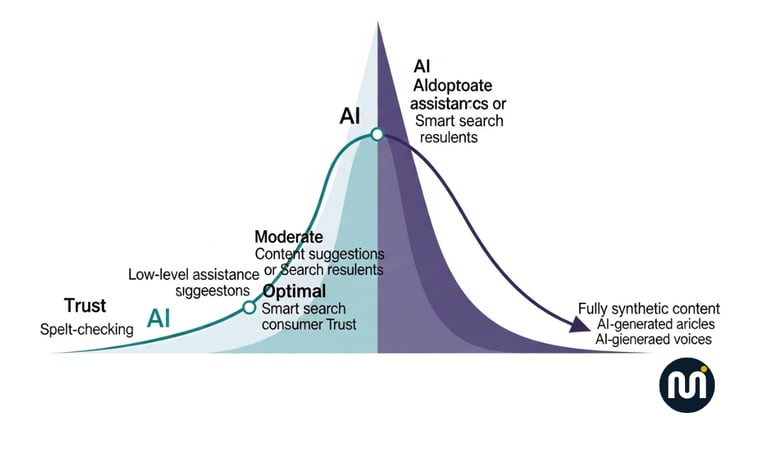
Strategic Implications: The Rise of "Artisanal" Communication
As we look toward 2030, the "Turing Insult" suggests a bifurcation of the digital economy.
1. The "Imperfection" Arbitrage
We are witnessing a bizarre market inversion where typos constitute a "Proof of Work." Just as consumers pay a premium for hand-stitched leather over factory-perfect vinyl, the "Smart Money" is betting on Verified Human content. Executives are now being coached to un-polish their communications—injecting idiosyncratic phrasing, abrupt transitions, and personal anecdotes that an LLM’s safety filters would smooth out.
2. Winners & Losers
Losers: High-Volume Content Marketing Agencies. The "SEO at scale" business model is dead. If Google’s algorithms don’t kill it, consumer disgust will.
Winners: Identity Verification Platforms. Tools that can cryptographically prove a human was behind a keyboard (like Worldcoin or similar "Proof of Personhood" protocols) will move from niche crypto-projects to enterprise necessities.
The Macro Trend: The Dead Internet Theory becomes reality. As the web floods with infinite AI noise, the value accrues to "Gated Communities"—Newsletters, Discords, and subscription media where human identity is gatekept.
What is "Synthetic Fatigue"?
Synthetic Fatigue is a psychological phenomenon where audiences instinctively disengage from content that exhibits the structural patterns of AI generation (e.g., perfect grammar, lack of strong opinion, repetitive lists). It results in lower retention and trust, forcing brands to adopt "messier," more human communication styles to signal authenticity.
The era of "Corporate Speak"—sanitized, perfectly punctuated, and ultimately empty—was already dying. AI just nailed the coffin shut.
Investors should look closely at operational expenses (OpEx). If a company is slashing its creative budget to replace writers with prompt engineers, they aren't "optimizing." They are leveraging their brand equity for short-term margin, risking a permanent disconnect with their customer base.
In a world where machines can generate infinite perfection for free, the only thing worth paying for is a human mistake.
If a typo increases your conversion rate by 15%, is "bad writing" now a fiduciary duty?
FAQ
1. How can I tell if a text is AI-generated? Look for the "hedging" instinct. AI models are trained to be agreeable and safe. They often use phrases like "It is important to note," utilize listicles of three points, and avoid taking a hard, controversial stance. If it says a lot without offending anyone, it’s likely synthetic.
2. Should companies stop using AI for copywriting? No, but they must change how they use it. AI should be the researcher, not the writer. The final output needs a "human pass" to inject voice, specific cultural references, and the "messiness" that signals a real person is behind the screen.
3. Will AI detection software solve this? Unlikely. The "arms race" between generators and detectors is a losing battle. The market solution won't be detection algorithms; it will be reputation. Trusted voices will carry a premium, while anonymous or generic content will trade at zero.
see Why Billionaires Are Quietly Cornering the Quantum Market with Alphabet
Related Stories
The Money Impact © 2026
Business and finance explained by impact.
